
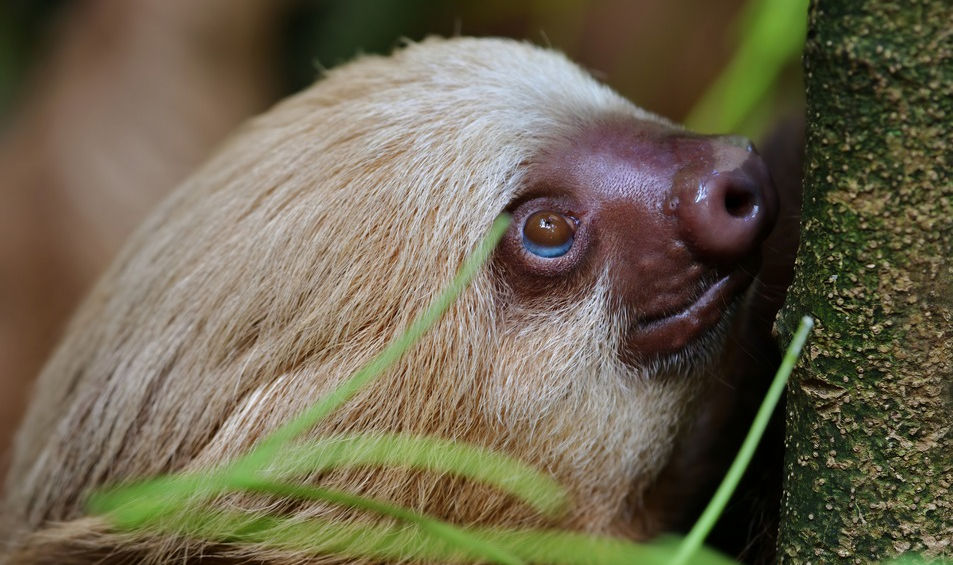
Paresseux à deux doigts
Nom scientifique : Choloepus hoffmanni
Famille : Megalonychidés
Description
The Two-toed Sloth is a large, arboreal mammal known for its relaxed lifestyle and slow movements. Unlike its close relative, the Three-toed Sloth, the Two-toed Sloth has only two claws on each foot (hence the name) rather than three. It has a shaggy, coarse fur that ranges from brown to grayish with a pale underside. One of the most distinctive features of the Two-toed Sloth is its face, which typically has a permanent, slightly “grinning” expression due to its mouth’s unique shape. It also has large, dark eyes and a relatively flat face, giving it an almost comical look.
The fur of the Two-toed Sloth often harbors algae, which helps camouflage the animal in the treetops. This algae growth can give the sloth a greenish tint, further aiding in its camouflage from predators, such as harpy eagles and jaguars. The sloth’s long, prehensile claws and arms allow it to move through the forest canopy with ease, even though it does so at an incredibly slow pace.
Size and Shape
The Two-toed Sloth is a medium-sized mammal. It typically measures 60-70 cm (24-28 inches) in body length, with a tail length of about 3-5 cm (1.2-2 inches). Its weight ranges from 4 to 8 kg (8.8 to 17.6 lbs), with males generally being slightly smaller than females. Its long, powerful arms make up a significant portion of its body length, and the claws on its feet are long and curved, ideal for gripping tree branches.
Its body is relatively large, with a stocky build and short legs. The Two-toed Sloth’s face is flattened with large, expressive eyes, and its ears are small and mostly hidden under fur. Despite its seemingly bulky frame, the Two-toed Sloth is built for hanging upside down and moving slowly through the canopy, where it spends nearly its entire life.
Habitat and Distribution
The Two-toed Sloth is primarily found in the tropical rainforests of Central and South America, with its range extending from southern Nicaragua and Honduras through Costa Rica, Panama, and into Colombia and western Venezuela. The species favors lowland rainforests, but it can also be found in montane forests at higher elevations. It is an arboreal animal, spending most of its time in the upper canopy of forests, where it moves slowly and feeds on leaves.
In Manuel Antonio, the Two-toed Sloth is a common resident. The park’s dense rainforests with their tall trees provide a perfect environment for this sloth species, offering plenty of opportunities to feed and rest in the treetops. Visitors to the park may spot the Two-toed Sloth hanging lazily from branches, sometimes going unnoticed due to its excellent camouflage.
Natural History and Behavior
The Two-toed Sloth is an herbivore, primarily feeding on a diet of leaves, fruit, and flowers. The species is well-adapted to living in the trees, with a slow metabolic rate that allows it to survive on its nutrient-poor diet. It feeds mostly on leaves from a variety of trees, including cecropia, as well as from palms and other plants. However, due to the tough, fibrous nature of these leaves, the sloth has a slow digestion process, which can take several days to break down the food.
Sloths are known for their slow and deliberate movements, and the Two-toed Sloth is no exception. Their low metabolism and specialized diet mean they conserve energy by moving slowly and spending a significant amount of time resting. These sloths may move only about 30 meters (100 feet) per day, and they often spend up to 20 hours a day resting or sleeping.
The Two-toed Sloth has a relatively solitary lifestyle, although individuals may interact with others during mating seasons. Communication between sloths is often limited to vocalizations such as low grunts or calls to attract mates. Unlike some other primates, sloths do not form tight social groups and are generally solitary for most of their lives.
Reproduction in the Two-toed Sloth occurs throughout the year, but mating tends to peak during the rainy season. Females give birth to a single offspring after a gestation period of approximately six months. The newborn sloth clings to its mother for several months, during which it is fully dependent on her for food and protection. Over time, the baby sloth grows more independent, but it may remain with the mother for up to a year before becoming more autonomous.
Conservation Status
The Two-toed Sloth is classified as Least Concern by the International Union for Conservation of Nature (IUCN), as the species has a relatively stable population and a wide distribution. However, like many species of tropical rainforests, it faces threats from habitat loss due to deforestation and human encroachment. Forests are cleared for agriculture, logging, and urban development, leading to fragmentation of the sloth's habitat.
The Two-toed Sloth is protected by the park's conservation efforts, which help safeguard its natural habitat. The park’s status as a protected area allows the species to continue to thrive in a relatively undisturbed environment, though ongoing conservation efforts are necessary to maintain the health of the forests and mitigate the threats posed by deforestation and human activities.
The Two-toed Sloth is an iconic member of the rainforest ecosystem, known for its slow pace and its specialized adaptations for life in the treetops. Its calm and solitary nature, combined with its unique appearance, make it one of the most fascinating creatures of Manuel Antonio National Park. Conservation of its tropical habitat is crucial to ensuring the continued survival of this slow-moving, enigmatic mammal.